Why You Haven’t Made Real Friends Abroad Yet — And How to Actually Change That
You’ve been here long enough. You can navigate the public transport, order coffee without checking your phone, and you know which supermarket has the best prices. And yet — you still feel like an outsider. Not unwelcome exactly. Just… not in.
If you’ve relocated to a cold-climate, individualist culture — think Scandinavia, Germany, the Netherlands, the UK, or Canada — this feeling is one of the most common things expats bring into sessions. And the data backs it up: it almost always comes down to the same misread.
48%
of globally mobile workers report feeling lonely abroad (Cigna Healthcare, 2023)
77%
of expatriates score above clinical loneliness thresholds — vs 47% of non-expats (Chen et al., 2025)
42%
global average of expats who find it easy to make local friends (InterNations, 2022)
Those numbers tell part of the story. But what the numbers don’t show is why — and whether the difficulty is really about the country, the culture, or the mismatch in relational expectations.
The Data Problem: It’s Not Just You
Every year, InterNations surveys over 10,000 expats across dozens of countries for its Expat Insider report. The findings on social integration are striking.¹ In the 2024 survey, the bottom ten countries for expat social ease included Finland (3rd worst), Germany (4th worst), Canada (5th worst), Norway (6th worst), and the UK (10th worst) — a near-perfect list of cold-climate, individualist nations.
Ease of Social Integration: Warm vs. Cold-Climate Expat Destinations
InterNations Expat Insider 2024 — Estimated ease of social integration score out of 100. Red = warm/collectivist. Black = cold/individualist.
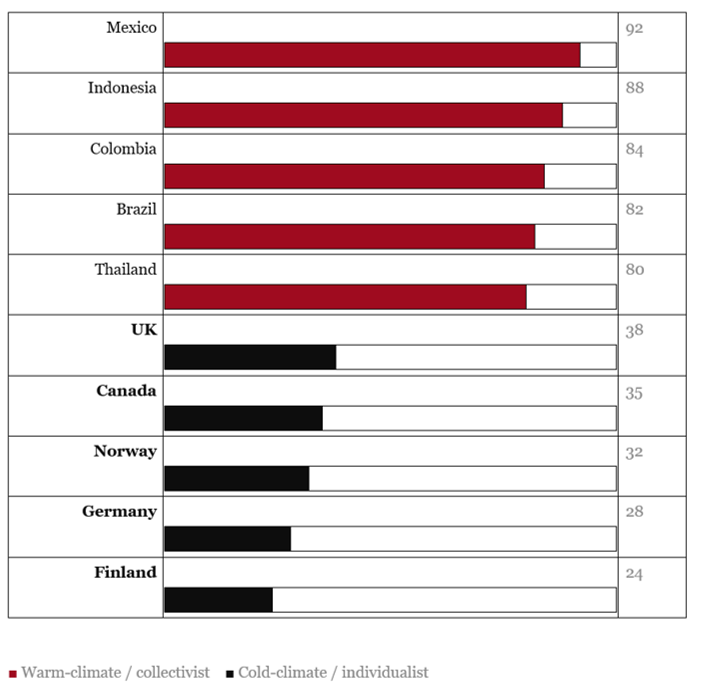
Compare that to Mexico, Indonesia, Colombia, and Brazil — all warm-climate, collectivist cultures where expats consistently report making friends quickly and feeling genuinely welcomed. The contrast is not subtle.
But here’s what the rankings miss: difficulty making friends in Germany or Finland doesn’t mean those cultures are unwelcoming. It means the rules of connection are different — and most expats arrive without a translation guide.
They’re Not Cold. They’re Operating on a Different Contract.
People from individualist, cold-climate cultures aren’t unfriendly. They’re private. Research by Lykes and Kemmelmeier found a meaningful difference in how loneliness functions across cultural types: in individualist societies, the absence of chosen friendships — rather than family ties or broad social networks — is what most predicts loneliness.⁵ In other words, these cultures invest deeply in a small number of carefully chosen relationships, not broadly in social warmth toward strangers.
When an expat from a warmer, more collectivist background encounters this, the instinct is often to try harder — to be warmer, more expressive, more open. Ironically, this can trigger the very withdrawal you were hoping to prevent.
“The shift that changes everything is moving from why won’t they let me in to what does intimacy actually look like here — and learning to value it on its own terms.”
What Actually Builds Depth in These Cultures
Consistency beats intensity. Depth in individualist cultures is built through repeated, low-stakes contact over time — not through one vulnerable conversation. The same gym class, the same colleague you grab lunch with, the same neighbour you wave to every morning. Showing up reliably, without agenda, is the currency of trust here.
Let them set the pace. These cultures build toward personal disclosure slowly, and they need to feel in control of that movement. The moment someone senses they’re being pushed toward intimacy before they’re ready, they pull back. Matching their rhythm — and waiting for them to shift the conversation to something more personal — signals that you’re safe to open up to.
Do things together, don’t just talk. In many warmer cultures, depth comes through conversation. Here, it often comes through shared activity. Hiking groups, sports clubs, amateur orchestras, community volunteering — doing something alongside someone builds trust faster and more naturally than any amount of talking about your feelings ever will.
Reframe directness as intimacy. When someone from this background gives you honest, blunt feedback — on your idea, your work, your plan — that’s often a sign of respect. They don’t bother being direct with people they don’t take seriously. Learning to receive this without defensiveness is one of the most underrated integration skills there is.
Get comfortable with silence. Silence isn’t awkward to them the way it might feel to you. Filling every quiet moment anxiously can read as intrusive. Learning to sit with a comfortable pause is, in itself, a form of closeness in these cultures.
A note on patience: Cigna Healthcare’s research on globally mobile workers found that even among expats who report feeling lonely, 78% still consider their relocation successful.¹ Social integration and life satisfaction aren’t the same thing — but building the former deepens the latter considerably. This isn’t a process you can accelerate. Measure progress in seasons, not weeks.
The Deeper Work
This kind of integration isn’t just a social skills question. It touches identity — who you are when the relational norms you grew up with no longer apply. It can surface grief for the ease of connection you had back home, frustration, and a creeping self-doubt that asks: is something wrong with me?
Nothing is wrong with you. You’re navigating a genuine cultural transition, and that takes real work. The expats who thrive long-term aren’t the ones who suppress their own relational style — they’re the ones who learn to hold both: staying true to who they are, while developing the fluency to connect across difference.
That’s exactly the kind of work that expat coaching and therapeutic support is designed for.
Ready to go deeper?
Lost Bob Immigration Dynamics works with internationally relocating professionals navigating culture shock and workplace integration.
REFERENCES
1.Cigna Healthcare International Health (2023). Loneliness and Isolation: The Hidden Struggle of Globally Mobile Workers. iPMI Global. ipmiglobal.com
2.Chen, Y. et al. (2025). Loneliness in long-term Taiwanese expatriates and domestic residents. ScienceDirect. sciencedirect.com
3.InterNations (2022). Expat Insider 2022 Survey Report. InterNations GmbH, Munich.
4.InterNations (2024). Expat Insider 2024 Survey Report. InterNations GmbH, Munich. Reported via Time Out and IamExpat.
5.Lykes, V. A. & Kemmelmeier, M. (2014). What Predicts Loneliness? Cultural Difference Between Individualistic and Collectivistic Societies in Europe. Journal of Cross-Cultural Psychology, 45(3). sagepub.com
Ready to go deeper?
Lost Bob Immigration Dynamics works with internationally relocating professionals navigating culture shock and workplace integration. Sessions run during Adelaide business hours.